Hannah Degoe, Thief, Resisting Execution

I’m in an editing phase of my work, which means I’m not producing as many new pieces. I’ve been taking breaks from the chapter I’m rearranging (so. much. rearranging.) to revisit some of my Patreon posts from a few years ago, and the following one caught my eye:
Research takes me down many rabbit holes, some of which are relevant to my work and others more tangential.
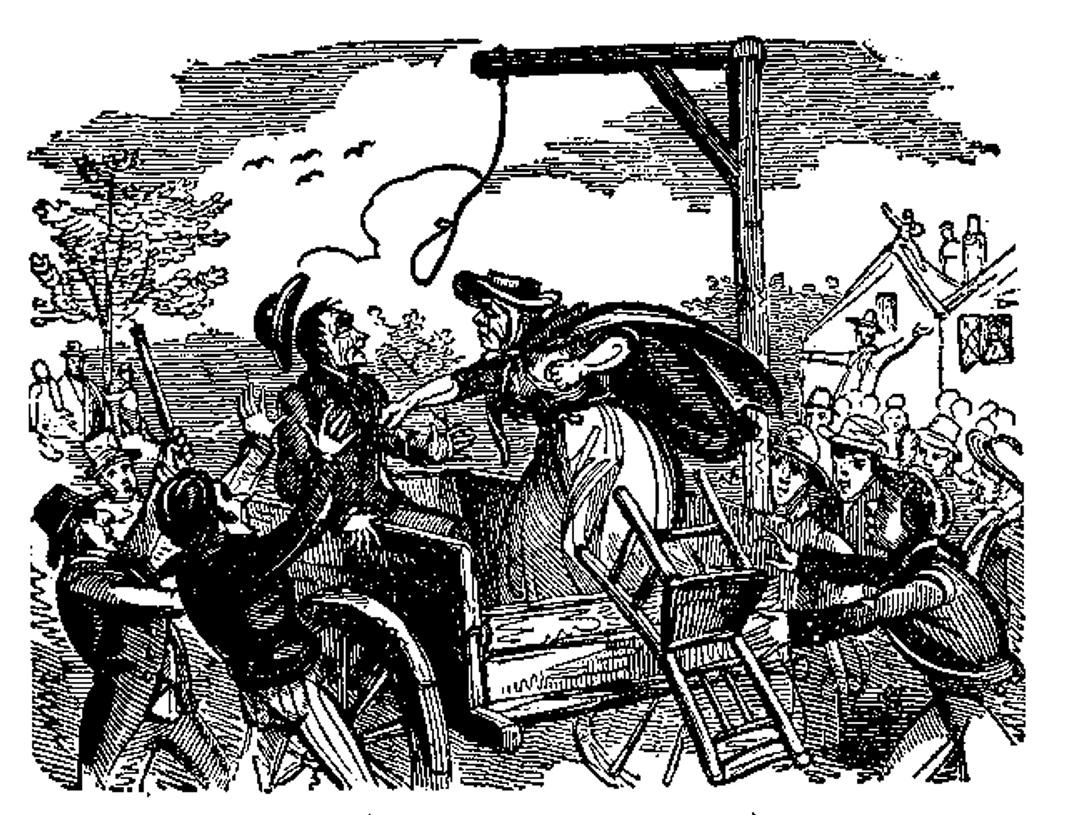
A reader sent me an email about a person they’d discovered in a museum exhibition. They had just watched my presentation, “A History of Striptease,” in which I defined striptease as “undressing with an audience in mind.” They sent me a photo of a museum panel that told briefly of Hannah Degoe, an 18th-century thief who was sentenced to hanging at Newgate. On her way to her death she fought with the guards, stabbing one (with what, I don’t know), and had to be wrestled up to the gallows. After having the noose fitted around her neck, she punched the executioner in the chest, ripped off her clothes and threw them to the observing crowd, then jumped off the edge of the platform, executing herself. Because her clothing was part of the executioner’s fee, she had just deprived him not only of doing the execution but of the value of reselling the clothing.
I researched her and found scans of the incident reports from 1763, so I feel I’ve checked enough that I'm comfortable retelling the story as presumably true.
The element I’m still researching is the practice of giving the criminal’s clothes to the executioner as part of his fee. It makes sense that used clothes might have had value, since this predates mass production and the invention of electric sewing machines. All fabric would have been worth a bit, even if only a few pennies from the ragpicker. I’m now looking for more information about the practice itself – whether it was standard where she was executed, how widespread it was, in which eras it was common, etc.
That’s probably not the best use of my time right now, but I thought you’d enjoy hearing how bizarre striptease research can get, leading down new avenues every time I try out a different definition.
I’m trying to pin down why this story captured me. My research is into the intersections of sex work with fashion and culture, and there’s no sign that this woman was a sex worker, or that her clothing was fashionable. I’m deeply fascinated by this story, even without have much information about her, knowing full well that I’m projecting. I love that she chose these final moments for rebellion. She not only refused to go quietly, but she also put on a show on her way out. She let the forces of authority know her utter contempt for them, even in the face of their life-and-death command over her. I think above all it’s her disinterest in dignity. She valued her rage and resistance more than the appearance of respectability, and I identify with that on every level.
Image of Hannah Gedoe resisting execution from the Newgate Calendar archives
https://www.exclassics.com/newgate/ngillus.htm
A record of the execution in 1763 according to newspapers.com, saying that she threw the clothes to her friends:
https://www.newspapers.com/clip/28065383/hannah-degoe-hung-for-house-robbery-1763/
More articles:
https://www.executedtoday.com/2008/05/04/
http://www.britishexecutions.co.uk/execution-content.php?key=2161
Note–I came across the execution of another Hanna Degoe in the same century in 1710, but they are decidedly not referring to the same incidents, as for example they might be if someone had just accidentally given the wrong years in one of the articles.
Then I also went down another set of rabbit holes looking up what executioners wore and how much they were paid, which is TOTALLY irrelevant to my work but was fascinating.
Tangents that take our focus from the main task are not just occasionally worthwhile but truly necessary, don’t you think? They help our minds exhale, draw in new breath.